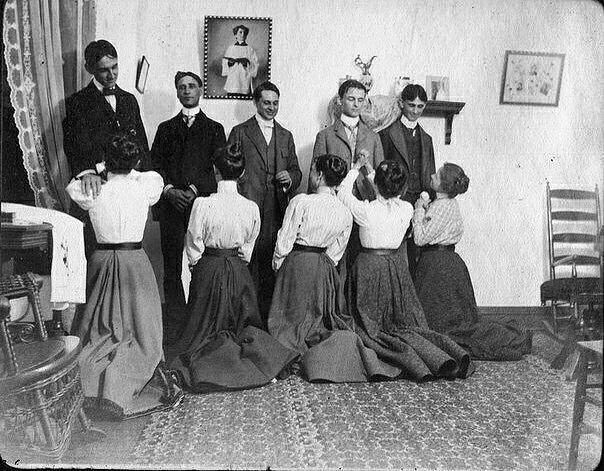
At the turn of the twentieth century, falling in love was a serious business. Courtship followed strict rules, and young people were watched closely by parents, aunts and chaperones. A young woman could not be seen alone with a man who was not a relative or her fiancé. Even holding hands in public could start gossip that followed her for years.
Young people still wanted to flirt, laugh and find out who liked whom. So they found a clever way around the rules: the parlor game.
The Heart of the Victorian Home
Before radio, television and movies, families made their own entertainment. In the evening, friends and neighbors gathered in the parlor, the best room in the house, to sing around the piano, recite poetry, tell stories and play games.
Because these gatherings took place in a family home, often with parents nearby, they were considered respectable. That made the parlor one of the few places where young men and women could mix freely.
And many of the games were designed for exactly that.
Bow, Kneel and Kiss
One of the most famous Victorian parlor games carried a playful command: bow to the wittiest, kneel to the prettiest, and kiss the one you love best.
A player would be sent around the room to follow the instructions. Everyone watched to see who would receive the bow, who would receive the kneel, and above all who would be chosen for the kiss.
It was a game, so no one could be blamed. But everyone in the room knew it was also a public confession. A single choice could reveal a secret crush, start a romance, or break a heart.
The Game of Forfeits
Many Victorian games used forfeits. When a player made a mistake or lost a round, they had to hand over a personal item, such as a glove, a ribbon, a handkerchief or a pocket watch.
To get it back, they had to perform a penalty chosen by the group. Penalties could be silly, like singing a song or imitating an animal. But they could also be romantic: kneeling before a chosen person, reciting a love poem, or giving a kiss.
Forfeits allowed young people to do things they would never dare to do on their own, all while claiming it was only part of the game.
Postman’s Knock and Other Kissing Games
Some games were even more daring. In “Postman’s Knock,” one player pretended to be a postman delivering a letter to someone waiting outside the door. The “postage” to be paid was often a kiss, given out of sight of the others.
Other games involved blindfolds, hiding, and guessing. In “Blind Man’s Buff,” a blindfolded player chased the others around the room, trying to catch and identify them by touch, which gave plenty of excuses for laughing, bumping and holding on.
Parents and chaperones usually tolerated these games. They happened in the open, among friends, and they offered a safe outlet for young romance under a watchful roof.
Staged for the Camera
Photographs like this one capture that playful spirit. Around 1900, cameras were becoming more common in middle-class homes, and young people loved staging funny or dramatic scenes for them.
Mock proposals, pretend weddings and playful scenes of women kneeling before men, or men kneeling before women, were popular jokes. They poked fun at the very serious rituals of courtship that everyone was expected to follow.
More Than Just a Game
For many couples, a parlor game was the beginning of something real. A kneel, a forfeit or a stolen kiss in a crowded room could turn into an afternoon walk, a visit to the family, and eventually a marriage proposal.
Behind the strict rules and stiff collars, young people of the Victorian and Edwardian eras were not so different from us. They wanted to laugh, to flirt and to fall in love. They just had to be a little more creative about it.